Your solar plant generated 200 units of electricity today. Your facility consumed 120. The remaining 80 units? Exported to the grid at ₹2–3 per unit, while you’ll buy it back tonight at ₹8–10. That gap right there is what most solar adopters quietly lose every single month.
This is the uncomfortable truth about standalone solar systems: generation and consumption rarely align. The sun is at its peak between 10 AM and 2 PM. Industrial loads often don’t. And without a way to bridge that gap, a significant portion of your clean energy investment simply doesn’t work as hard as it should.
This is precisely where a solar battery storage system changes the equation, not marginally, but fundamentally.
Solar Without Storage Is Only Half the Solution
There’s a reason the conversation around solar has shifted so dramatically over the past few years. The panels themselves have become highly efficient, competitively priced, and relatively straightforward to install. But what’s become clear, especially for commercial and industrial clients operating round the clock, is that generation alone doesn’t equal energy independence.
Think about a warehouse or manufacturing unit. Power demand spikes during shift changes, machine startups, and HVAC peak hours, often in the evening, when solar output has dropped to near zero. Without storage, the only fallback is the grid. And in cities like Mumbai, where commercial electricity tariffs have been steadily climbing, that fallback comes at a steep price.
Solar energy storage solutions solve this at the root. They decouple generation from consumption, allowing businesses to use solar power when it’s actually needed, not just when the sun decides to cooperate.
What a Battery Energy Storage System Actually Does
Let’s move past the marketing language and look at what happens in practice.
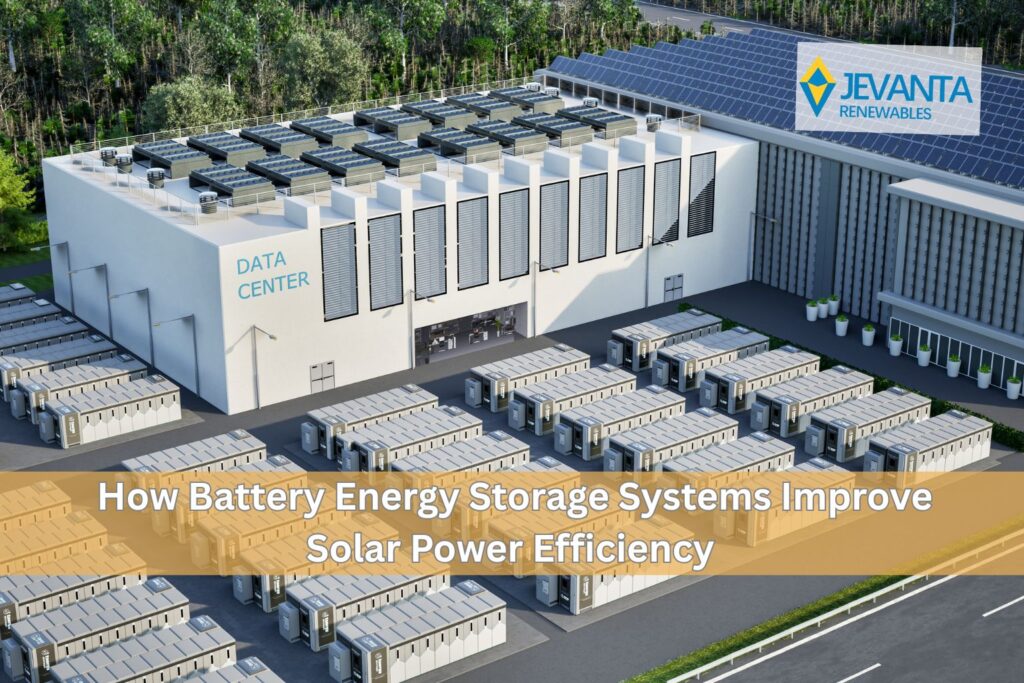
A Battery Energy Storage System (BESS) is an integrated setup that captures surplus electricity from your solar array, stores it in high-capacity battery units, and releases it on demand, based on your operational requirements, grid availability, or pre-set intelligent controls.
Here’s where things get interesting: modern BESS units don’t just store and discharge. They actively optimise. Through smart energy management software, the system tracks your consumption patterns, predicts peak-demand windows, and manages load distribution to avoid demand charges, which, for large industrial consumers, can account for 20–30% of their monthly electricity bill alone.
Battery storage for solar plants typically functions across three critical modes:
- Peak shaving, drawing from stored energy during high-tariff or high-demand periods, reduces grid dependency
exactly when it costs the most. - Load shifting, storing cheap or self-generated solar power and using it during expensive grid-draw windows.
- Backup power, providing seamless continuity during outages, without the noise, fuel cost, or emissions of a diesel generator.
In our experience working with industrial clients across Maharashtra and beyond, the combination of peak shaving and load shifting routinely delivers 25–35% additional savings beyond what a standalone solar installation achieves. That’s not a small number.
Why Mumbai Businesses Need This More Than Most
Battery energy storage systems in Mumbai aren’t a luxury; they’re increasingly a strategic necessity.
Mumbai’s commercial electricity landscape presents a specific set of challenges. Frequent grid fluctuations during monsoon months, high peak-hour tariffs under MSEDCL’s time-of-use pricing, and the sheer density of commercial operations all create conditions where energy reliability and cost control become business-critical concerns.
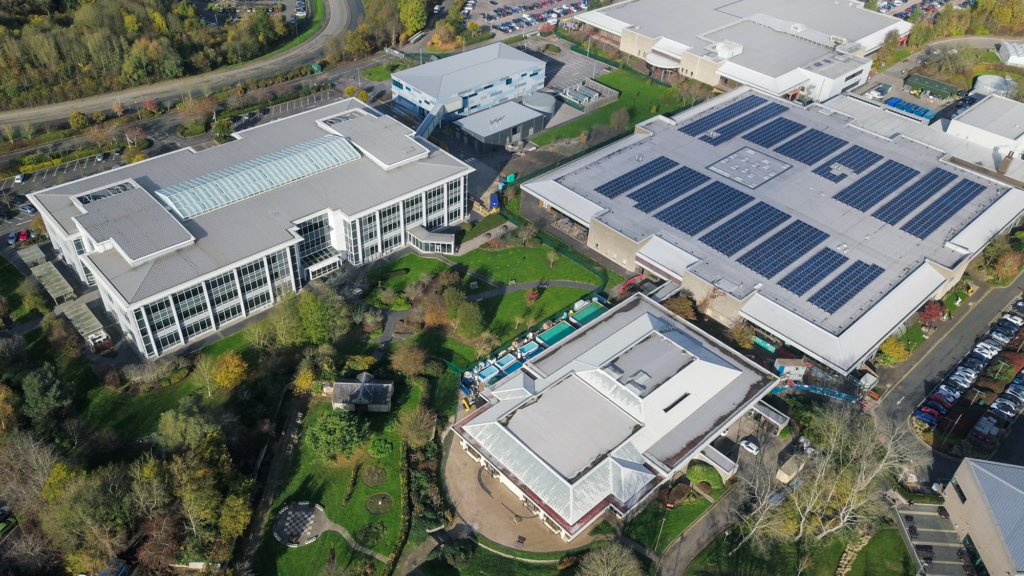
At the same time, rooftop space in Mumbai is finite. Most commercial buildings can only host solar systems of a certain capacity. If you’re generating only as much as your rooftop allows, and exporting the surplus at low rates instead of storing it, you’re effectively subsidising the grid rather than your own operations.
Solar with battery backup in Mumbai addresses both problems. It maximises the value of every unit generated, ensures power continuity without diesel backup, and gives facilities managers a predictable, managed energy ecosystem rather than a reactive one.
What most people don’t realise is that for businesses with a connected load above 100 kW, such as factories, large warehouses, hospitals, and data centres, the ROI on a BESS integration often rivals and sometimes exceeds the ROI of the solar installation itself, particularly when demand charge savings are factored in.
The Integration Edge: BESS + Solar as One Intelligent System
A standalone solar system and a standalone battery system are both useful. But a properly integrated solar energy storage solution, where both components are engineered to work as a unified system, is a different animal altogether.
At Jevanta Renewables, we design BESS configurations that don’t just sit alongside a solar plant but actively communicate with it. The battery management system (BMS) monitors real-time generation, predicts the impact of cloud cover, tracks consumption loads, and makes intelligent decisions, all without manual intervention.
For example, during a cloudy period that reduces solar output by 40%, the system seamlessly compensates using storage rather than drawing from the grid. When generation rebounds, the batteries recharge optimally without overcharging or unnecessary cycling, which directly extends battery lifespan.
This kind of intelligent integration is what separates a well-engineered BESS deployment from a generic add-on. It’s also why the design and assessment phase matters as much as the hardware itself. A system sized incorrectly, either too small to handle peak loads or oversized for actual consumption, will underperform and distort the financial case.
Sizing, Technology, and What to Look For
Not all batteries are created equal, and the technology you choose will significantly impact long-term performance.
Lithium Iron Phosphate (LFP) batteries are currently the preferred choice for commercial and industrial solar storage. They offer superior thermal stability, longer cycle life (typically 3,000–6,000 cycles), and a better safety profile compared to older lithium-ion chemistries, making them well-suited for large-scale industrial deployments.
When evaluating a solar battery storage system, these are the parameters that actually matter:
- Usable capacity (kWh), not just rated capacity, but how much energy you can realistically discharge per cycle.
- Round-trip efficiency, A good BESS should retain 90–95% of the energy put in; anything significantly lower means you’re losing value on every cycle.
- Depth of discharge (DoD): A higher DoD means more of the battery capacity is accessible, which affects both sizing decisions and economics.
- For industrial applications, look for systems with a warranty of at least 10 years or 3,000+ cycles.
- O&M support, A BESS is a long-term asset. Remote monitoring, predictive maintenance, and responsive technical support aren’t optional extras; they’re essential.
The Financial Picture: Where the Numbers Land
For a commercial facility with a monthly electricity bill in the range of ₹5–15 lakhs, a well-designed BESS integration can deliver additional monthly savings of ₹80,000–₹2.5 lakhs, depending on tariff structure, load profile, and system capacity.
Combined with the savings from the solar installation itself, the total payback period for a solar-plus-storage system typically ranges from 4 to 6 years, after which the system generates essentially free, reliable power for another 15+ years.
CAPEX, RESCO, and BOOT financing models, all of which Jevanta Renewables offers, also mean businesses don’t always have to bear the upfront capital requirement. A RESCO model, for instance, allows you to benefit from storage-backed solar power with zero initial investment, paying only for the units consumed at a pre-agreed rate.
The Direction Things Are Heading
India’s push toward a 500 GW renewable energy target by 2030 isn’t just a government ambition; it’s reshaping how businesses think about energy. Grid reliability will improve, but so will grid pricing. Businesses that have invested in battery storage for their solar plants will be better positioned to navigate that landscape, with more control, more predictability, and less exposure to external tariff volatility.
The companies that are getting ahead of this today, integrating storage as part of their energy infrastructure rather than treating it as an afterthought, are the ones that will have a meaningful cost advantage in the years ahead.
A Final Word
A solar installation without storage is a good start. A solar installation paired with an intelligently designed battery energy storage system is a complete energy strategy.
If you’re operating a facility in Mumbai or anywhere across India and want to understand how BESS can improve both the efficiency and economics of your solar investment, Jevanta Renewables offers detailed energy assessments and custom system designs, backed by 950+ MW of commissioned projects and 25+ years of combined expertise.
The question isn’t really whether energy storage makes sense. It’s whether your current setup is leaving value on the table.