A Complete, Simple, and Human Explanation by Jevanta Renewables
Solar power is everywhere around us. We feel it every morning when the sun rises, we depend on it for warmth, and now—more than ever—we are using it to generate clean, affordable electricity.
The big question most people ask is:
“How solar energy is converted to electrical energy?”
Suppose you’re a homeowner, industry owner, or commercial property manager in Mumbai, Thane, Navi Mumbai, Pune, Nashik, Aurangabad, or anywhere in India. In that case, you’ve probably thought about going solar to reduce costs and ensure reliable power.
But understanding how solar works helps you make a more confident decision.
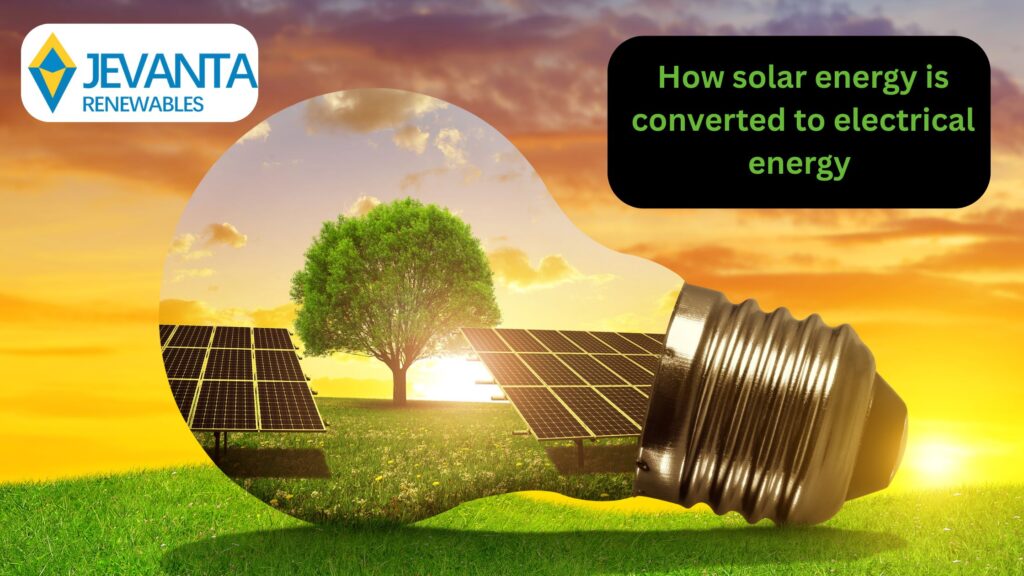
In this blog, Jevanta Renewables explains the process step by step, in the simplest way possible, with practical examples from both homes and industries.
Let’s begin.
Understanding Solar Energy in Simple Terms
Solar energy comes from sunlight. Using specially designed devices called solar photovoltaic (PV) panels, we can convert that sunlight into usable electricity.
This electricity can then power:
- Lights
- Fans
- Air conditioners
- Machines
- Industries
- Offices
- Entire buildings
What was once only a scientific theory is now powering millions of Indian homes and industries every single day.
How Solar Energy Is Converted to Electrical Energy (Simple Explanation)
Let’s break down the full process in a human-friendly way.
The conversion of solar energy into electrical energy happens through five primary stages:
- Sunlight falls on solar panels (PV effect begins)
- Panels generate DC electricity.
- An inverter converts DC into AC.
- AC electricity powers appliances/machines
- Excess power goes to batteries or the grid.
Whether it’s a home in Thane or an industrial plant in Taloja, this process remains the same.
Let’s look at these steps in detail.
Step 1 — Sunlight Falls on Solar Panels
Solar panels are made up of many tiny units called solar cells. These cells are usually made of silicon, a semiconductor material.
When sunlight hits these cells:
- Photons (light particles) strike silicon atoms.
- Electrons inside the silicon begin to move.
- This movement of electrons creates electricity.
- This phenomenon is called the Photovoltaic Effect.
It’s the heart of how solar energy is converted to electrical energy.
Why silicon?
Because silicon:
- Absorbs sunlight efficiently
- Is long-lasting (25–30 years)
- Is stable
- Is affordable
This is why nearly all solar panels in homes and industries rely on silicon-based PV technology.
Step 2 — Solar Panels Generate DC Electricity
The electricity produced by solar panels is DC (Direct Current).
This means:
- Electricity flows in one direction.
- Suitable for storage in batteries
- Not suitable for most household or industrial appliances
- DC power is raw solar power, but not yet ready for real-world use.
The amount of DC produced depends on:
- Panel quality
- Sunlight intensity
- Panel angle
- Temperature
- Shading
- Dust or dirt
This is why Jevanta Renewables conducts site surveys to determine the optimal installation angle, orientation, and placement for maximum performance.
Step 3 — Inverter Converts DC to AC
Homes, offices, and industries run on AC (Alternating Current).
So once solar panels produce DC electricity, it flows to a device called an inverter.
The inverter performs three main tasks:
- Converts DC to AC
- Ensures voltage stability
- Synchronises with grid electricity
Modern inverters (like hybrid inverters) also:
- Manage battery charging
- Regulate energy flow
- Provide monitoring
- Protect the system from faults
This is why the inverter is often called the brain of the solar system.
Step 4 — AC Electricity Powers Homes and Industries
Now that DC power is converted to AC, it can be used to run:
In Homes:
- Lighting
- Fans
- TV
- Refrigerator
- Air conditioner
- Water pump
- Home appliances
In Industries:
- Motors
- Compressors
- Machinery
- Production lines
- Cooling systems
- Welders
- Pumps
- HVAC systems
Solar power gets distributed through the main distribution board just like regular electricity.
So when you use a solar-powered home or factory, everything feels the same—but your energy bill drops dramatically.
Step 5 — Excess Solar Energy Goes to Batteries or the Grid
Depending on the type of system you use, extra power is either stored or exported.
A. Grid-Tied Solar Systems (Most Common in Cities)
Extra solar electricity is sent to the grid.
You receive credits through a system called net metering.
Perfect for:
- Homes in societies
- Commercial buildings
- Industries with daytime load
B. Hybrid Solar Systems (Solar + Battery)
Extra energy charges the batteries.
Perfect for:
- Power-cut areas
- Homes or shops needing night backup
- Hospitals and essential industries
C. Off-Grid Solar Systems
These are entirely independent of the grid.
All excess energy goes into batteries.
Ideal for:
- Rural areas
- Remote industries
- Farms
- Locations with no grid supply
The Complete Science Behind Solar Energy Conversion (Explained Simply)
Let’s simplify the science behind how solar energy is converted to electrical energy.
1. Absorption:
Panels absorb sunlight.
2. Electron Movement:
Photons energise electrons in silicon.
3. Electric Current Formation:
Moving electrons creates DC electricity.
4. Conversion:
An inverter converts DC to AC.
5. Usage or Storage:
Electricity powers loads or gets stored/exported.
That’s it!
Simple, clean, and natural—just like solar energy itself.
How Conversion Works in Homes vs Industries
Though the science remains the same, the scale and technology differ.
Solar for Homes
Residential solar systems are usually:
- 1 kW to 10 kW
- Rooftop-mounted
- Connected with net metering
- Optional battery storage
Benefits:
- Lower electricity bills
- Backup during outages (with batteries)
- Sustainable living
- Higher property value
- Solar for Industries
Industrial solar systems are:
- 50 kW to multi-MW
- Installed on factory roofs or open land
- Designed for heavy machinery
- Often combined with battery energy storage.
- Integrated with AI/ML monitoring for peak efficiency
Industries benefit from:
- Massive reduction in energy costs
- Lower diesel generator expenses
- Improved ESG scores
- More reliable power
- Lower carbon emissions
Jevanta Renewables specialises in large industrial solar, microgrids, and utility-scale solar, making the process seamless for manufacturing units, warehouses, textiles, engineering companies, and more.
Key Components Involved in Solar Energy Conversion
To fully understand how solar energy becomes electrical energy, here are the essential components:
1. Solar Panels (PV Modules)
Capture sunlight and convert it to DC electricity.
2. Solar Inverter
Converts DC to AC.
3. Mounting Structures
Hold panels at the right angle.
4. DCDB / ACDB
Protective distribution boxes for safe current flow.
5. Batteries (Optional)
Store energy for night use or power cuts.
6. Charge Controller
Manages battery health (in hybrid/off-grid systems).
7. Net Meter
Tracks the import/export of electricity.
8. Wiring & Safety Systems
Ensure stable and safe operation.
Each component plays a crucial role in the overall conversion process.
Why Solar Conversion Is So Efficient Today
Thanks to advancements in solar technology:
- Panel efficiency has increased.
- Inverters are smarter
- Batteries are more reliable.
- Monitoring is AI-driven
At Jevanta Renewables, we use:
- Tier-1 solar panels
- High-efficiency inverters
- Lithium-ion battery systems
- Smart microgrids
- Remote monitoring technology
This ensures maximum output and long-term performance.
Real-Life Example — How Solar Powers a Home
A 5 kW residential system in Thane:
- Generates 20–25 units/day
- Powers all regular appliances
- Cuts electricity bills by 70–90%
- Gives 4–6 hours of backup (hybrid mode)
The homeowner enjoys clean, uninterrupted electricity—without worrying about rising tariffs.
Real-Life Example — How Solar Powers an Industry
A 500 kW industrial system in Navi Mumbai:
- Generates 2,000+ units/day
- Runs heavy machinery
- Gives annual savings of ₹25–35 lakhs
- Reduces diesel generator consumption
- Helps meet ESG goals
- Runs efficiently with AI-based monitoring
This is why industries across India are rapidly switching to solar.
Why Jevanta Renewables Is the Best Choice for Solar in Homes & Industries
Jevanta Renewables is not just a solar installer—we are a full-stack renewable energy solutions company with expertise across:
- Solar rooftop
- Solar for industries
- Utility-scale solar
- Solar + battery systems
- Microgrids
- Green infrastructure
- Waste-to-energy
What Makes Us Different?
- 25+ years of combined expertise
- 950+ MW delivered globally
- AI/ML-powered monitoring
- End-to-end EPC + O&M services
- High-quality components
- Custom solutions for every client
- Strong presence across Mumbai & Maharashtra
- Transparent pricing & long warranties
When you choose Jevanta, you choose reliability, quality, and long-term performance.
Final Thoughts — Solar Energy Is the Future, and Conversion Makes It Possible
Understanding how solar energy is converted to electrical energy helps you appreciate the science, simplicity, and sustainability behind solar power.
Whether you are a homeowner or an industry owner:
- Solar saves money
- Solar gives independence
- Solar provides reliable power.
- Solar supports sustainability goals.
- Solar prepares you for the future.
The conversion process may sound technical, but it is beautifully simple—and life-changing for those who adopt it.
Want to Install Solar for Your Home or Industry? Contact Jevanta Renewables
Mumbai Office:
A-409, Kailas Business Park, Veer Savarkar Road, Vikhroli (W), Mumbai 400079
Phone:
+91-8879977089