Electricity has become one of the biggest operating expenses for businesses, industries, institutions, and even residential communities. While switching to solar is an obvious solution, choosing the wrong type of solar system can reduce your return on investment or fail to meet your energy needs. That’s why understanding the on-grid vs off-grid solar system debate is just as important as deciding to invest in solar itself.
The reality is that there isn’t a one-size-fits-all solution. The right system depends on your location, power availability, energy consumption, and future expansion plans. In our experience, businesses that spend time evaluating these factors before installation achieve better long-term savings and greater energy reliability.
Let’s break down the differences between on-grid, off-grid, and hybrid solar system solutions so you can make an informed decision.
Understanding the Three Types of Solar Systems
Although all solar systems convert sunlight into electricity using photovoltaic (PV) panels, the way they store and distribute power differs significantly.
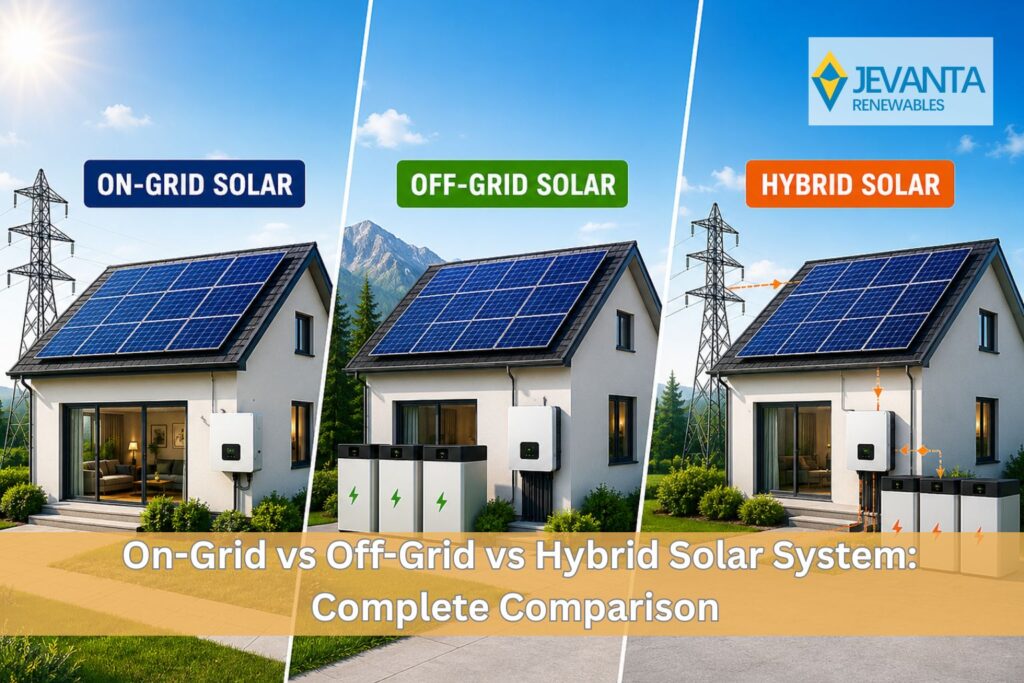
What is an On-Grid Solar System?
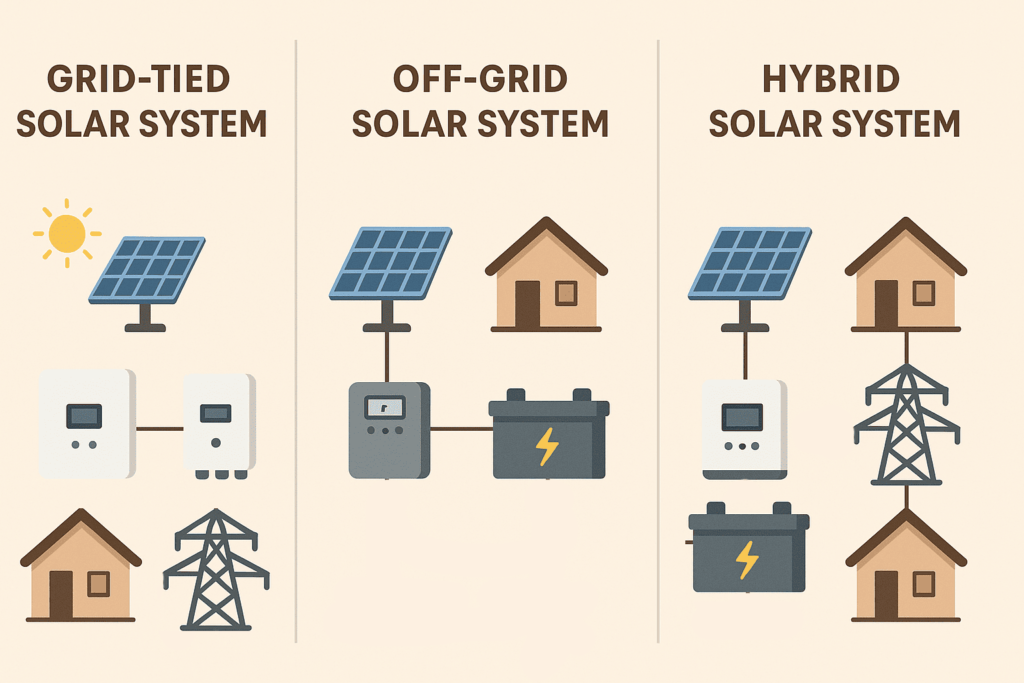
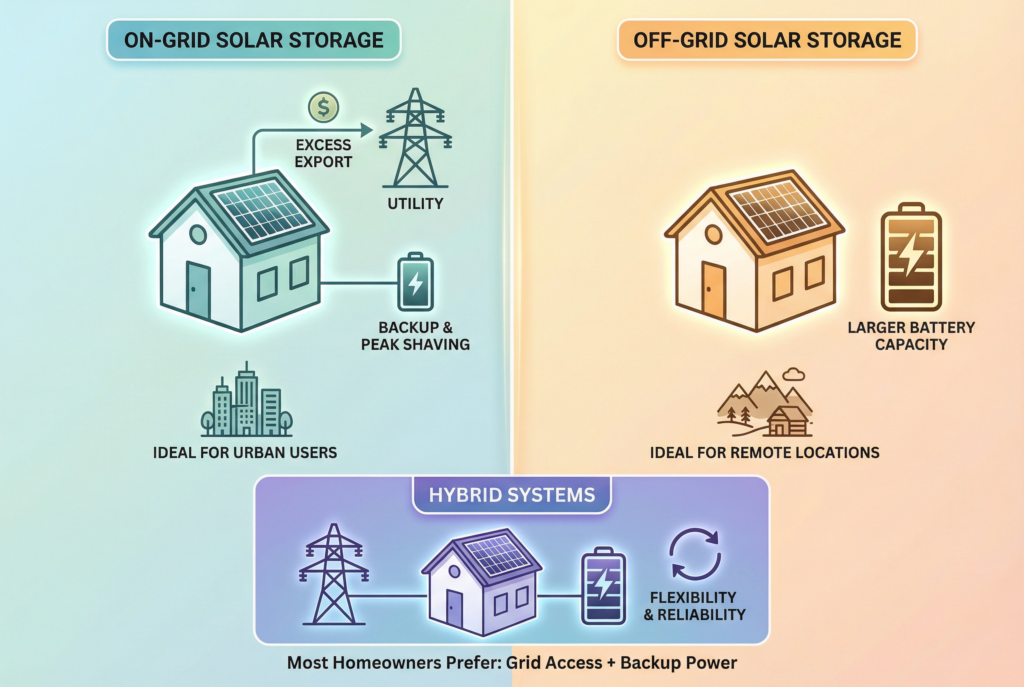
During the day, your solar panels yield electricity to power your facility. If the panels produce more electricity than you’re consuming, the excess energy is exported to the utility grid through net metering. At night or during overcast conditions, electricity is drawn from the grid.
This is currently the most common choice for commercial buildings, factories, educational institutions, residential societies, and offices located in areas with a reliable electricity supply.
Advantages of On-Grid Systems
- Reduced electricity bills through net metering
- Higher return on investment
- Minimal maintenance requirements
- Efficient use of generated solar power
Limitations
- Does not provide backup during power outages unless paired with additional backup solutions
- Depends entirely on grid availability
For organisations looking to reduce operating costs while maintaining a reliable grid connection, on-grid systems remain one of the most economical options.
What is an Off-Grid Solar System?
An off-grid solar system functions independently of the electricity grid. It uses batteries to keep excess solar energy generated during the day, allowing power to be used at night or during periods of low sunlight.
These systems are commonly installed in remote villages, isolated industrial sites, farms, telecom towers, mining operations, and locations where grid connectivity is unavailable or unreliable.
Advantages of Off-Grid Systems
- Complete energy independence
- Reliable electricity in remote locations
- Protection from rising utility tariffs
- Continuous power with adequate battery storage
Limitations
- Higher initial investment because of battery storage
- Batteries require periodic replacement
- Larger system sizing is necessary to ensure uninterrupted power
What most people don’t realise is that battery storage often represents a significant portion of the overall project cost. Proper load analysis and system design are essential to avoid overspending.
What is a Hybrid Solar System?
A hybrid solar system combines the advantages of both on-grid and off-grid systems. It remains connected to the utility grid while also incorporating battery storage.
During the day, solar energy powers your facility first. Excess electricity charges the batteries before exporting surplus power to the grid. During power failures, the batteries automatically supply electricity to selected loads, ensuring uninterrupted operations.
This makes hybrid systems particularly attractive for businesses where downtime can result in production losses or operational disruptions.
Advantages of Hybrid Systems
- Reduced electricity bills
- Backup power during outages
- Better utilisation of solar energy
- Increased energy security
- Flexibility for future energy expansion
Limitations
- Higher upfront investment compared to on-grid systems
- More complex system design
- Battery maintenance requirements
As battery technology persists to improve and costs gradually decline, hybrid solutions are becoming increasingly popular among industries and commercial establishments.
On-Grid vs Off-Grid Solar System: Key Differences
Here’s where things get interesting. While both systems generate clean energy, their purpose and performance differ considerably.
| Feature | On-Grid | Off-Grid | Hybrid |
| Connected to Utility Grid | Yes | No | Yes |
| Battery Storage | No | Yes | Yes |
| Backup During Outages | No | Yes | Yes |
| Initial Investment | Low | High | Medium to High |
| Electricity Bill Savings | Excellent | Not Applicable | Excellent |
| Best For | Urban & Industrial Areas | Remote Locations | Businesses Requiring Backup |
Understanding the on-grid vs off-grid solar system comparison helps eliminate confusion during the planning stage and ensures your investment aligns with your operational requirements.
Which Solar System is Right for You?
Selecting the right solution isn’t just about budget. It should align with your energy goals.
Choose an On-Grid System If:
- You have consistent utility power.
- Your objective is to reduce electricity bills.
- Net metering is available in your area.
- You want the quickest return on investment.
Choose an Off-Grid System If:
- Your location has little or no grid connectivity.
- Reliable electricity is unavailable.
- Energy independence is your highest priority.
Choose a Hybrid Solar System If:
- Your operations cannot afford power interruptions.
- You want both savings and backup power.
- You expect future expansion.
- You need greater energy resilience.
Why System Design Matters More Than System Type
One of the biggest mistakes businesses make is choosing a solar system based solely on price.
Even the best equipment won’t perform efficiently if the system isn’t properly designed. Factors such as roof direction, energy consumption patterns, battery sizing, inverter capacity, and future load growth all influence long-term performance.
This is where experienced engineering teams make a significant difference.
Companies like Jevanta Renewables begin every project with a detailed site assessment and energy analysis rather than recommending a standard solution. This approach ensures every installation is designed for maximum efficiency, safety, and long-term savings.
Why Businesses Are Investing in Smarter Solar Solutions
As electricity prices resume to rise and sustainability becomes a business priority, solar is no longer viewed simply as an environmental initiative. It’s becoming a strategic financial decision.
Manufacturing plants are reducing operational costs.
Commercial buildings are improving energy efficiency.
Institutions are lowering recurring utility expenses.
Industrial facilities are increasing energy reliability.
Choosing the right solar architecture today can continue delivering savings for decades.
Choosing the Right Solar Partner
Beyond understanding the on-grid vs off-grid solar system options, selecting an experienced implementation partner is equally important.
A reliable installer doesn’t simply install solar panels. They evaluate your energy consumption, recommend the appropriate technology, ensure regulatory compliance, optimise system performance, and provide long-term operational support.
Working with an experienced solar panel company in Mumbai ensures quality engineering, certified components, professional project execution, and ongoing maintenance support to back your investment.
Conclusion
The comparison between on-grid vs off-grid solar system solutions ultimately comes down to your energy requirements, operational priorities, and long-term business objectives. While on-grid systems deliver exceptional cost savings, off-grid systems provide complete independence, and a hybrid solar system offers the best of both worlds through savings and uninterrupted power.
For businesses planning a long-term investment in renewable energy, partnering with an experienced solar panel company in Mumbai, such as Jevanta Renewables, can make all the difference. With expertise across rooftop solar, utility-scale projects, battery energy storage systems, and customised clean energy solutions, Jevanta helps organisations implement solar systems that are designed for performance, reliability, and lasting value.