Introduction: India at the Turning Point of Its Energy Story
India is standing at a decisive crossroads in 2026. With rising energy demand, climate commitments, volatile fossil fuel prices, and rapid technological advancements, the country is no longer asking whether it should move to renewable energy—but how fast it can.
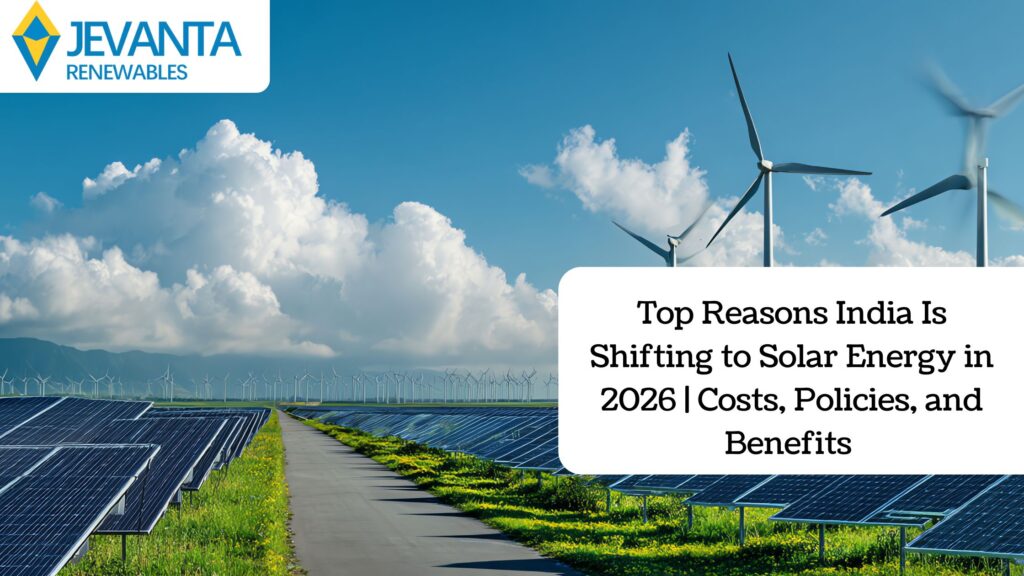
Among all renewable sources, solar energy has emerged as the clear front-runner. The shift towards Solar Energy in 2026 is not accidental, nor does a single factor drive it. It is the outcome of economics, policy reforms, environmental responsibility, and a fundamental change in how businesses and institutions view energy.
At Jevanta Renewables, we witness this transformation on the ground—across industrial rooftops, utility-scale projects, microgrids, and hybrid energy systems. Solar energy is no longer an “alternative”; it is becoming the default choice.
This blog explores why India is rapidly shifting to solar energy in 2026, covering cost trends, government policies, economic benefits, environmental impact, and long-term strategic advantages for businesses and communities alike.
Rising Energy Demand and the Limits of Conventional Power
India’s electricity demand has been growing at an unprecedented pace. Rapid urbanisation, industrial expansion, data centre growth, EV adoption, and rising per-capita consumption have put immense pressure on the national grid.
Key challenges with conventional energy:
- Heavy dependence on coal imports
- Fluctuating fuel prices
- Grid congestion and transmission losses
- High carbon emissions
- Environmental and health costs
Coal-based power plants are struggling to keep up—not just operationally, but economically and environmentally. In contrast, solar energy offers scalability without fuel dependency.
The shift towards Solar Energy in 2026 reflects India’s realisation that future energy security cannot rely on finite, import-dependent fuels.
Solar Energy Costs Have Reached Historic Lows
One of the strongest drivers behind the shift is cost economics.
Over the past decade, solar tariffs in India have dropped by more than 80%. By 2026, solar power will be one of the cheapest sources of electricity, often cheaper than new coal or gas-fired generation.
Why solar is cost-effective in 2026:
- Zero fuel cost
- Predictable long-term pricing
- Reduced operation and maintenance expenses
- Improved panel efficiency
- Competitive EPC and installation costs
For industries and commercial establishments, this translates into lower electricity bills, long-term cost certainty, and protection against tariff hikes.
At Jevanta Renewables, we design solar solutions that maximise ROI by optimising system size, orientation, storage integration, and lifecycle performance—making solar not just green, but financially savvy.
Strong Government Policies and Regulatory Support
Government intervention has played a pivotal role in accelerating the shift towards Solar Energy in 2026.
India’s renewable energy roadmap is backed by long-term national commitments and state-level incentives, creating confidence for investors, developers, and consumers.
Key policy enablers:
- National Solar Mission targets
- Renewable Purchase Obligations (RPOs)
- Net metering and open access frameworks
- Capital subsidies for specific segments
- Faster approvals and single-window clearances
In 2026, policy focus has shifted from promotion to integration—ensuring that solar power is seamlessly embedded into industrial, commercial, and urban infrastructure planning.
Jevanta Renewables works closely within these regulatory frameworks to help clients navigate compliance, approvals, and incentive optimisation—ensuring smooth project execution.
Corporate Sustainability and ESG Pressures
Indian businesses are undergoing a mindset shift. Sustainability is no longer a branding exercise—it’s a boardroom priority.
Why corporates are choosing solar in 2026:
- ESG compliance requirements
- Investor and stakeholder pressure
- Carbon neutrality targets
- Supply chain sustainability mandates
- Global reporting standards
Solar energy directly contributes to Scope 2 emission reduction, making it one of the fastest ways for organisations to meet sustainability goals.
At Jevanta Renewables, we support ESG-aligned solar deployments—combining rooftop solar, utility-scale installations, and battery storage systems that deliver measurable environmental impact alongside economic benefits.
Energy Independence and Risk Mitigation
One of the less-discussed but critical reasons for the shift towards solar energy is risk management.
Traditional power sources expose businesses to:
- Fuel price volatility
- Power outages
- Grid instability
- Policy uncertainty
Solar energy, especially when combined with battery storage or microgrids, offers energy independence.
Benefits include:
- Reduced reliance on grid power
- Backup during outages
- Stable energy supply for critical operations
- Better control over energy costs
Industries, hospitals, campuses, and data centres increasingly prefer solar + storage solutions, a space where Jevanta Renewables has developed deep technical expertise.
Rapid Advancements in Solar Technology
Technology evolution has made solar systems more innovative, more efficient, and more reliable in 2026.
Key technological improvements:
- Higher-efficiency photovoltaic panels
- Bifacial and mono PERC modules
- Advanced inverters and monitoring systems
- AI-driven performance optimisation
- Battery Energy Storage Systems (BESS)
These advancements mean:
- More power from less space
- Better performance even in low-light conditions
- Real-time system monitoring and predictive maintenance
At Jevanta Renewables, technology selection is never generic. Each solar project is engineered based on site conditions, load profiles, and long-term performance goals.
Urbanisation and Rooftop Solar Adoption
India’s cities are expanding rapidly—and rooftops are becoming valuable energy assets.
The shift towards Solar Energy in 2026 is clearly visible in:
- Commercial buildings
- Warehouses and logistics parks
- IT campuses
- Educational institutions
- Residential societies
Rooftop solar helps cities:
- Reduce grid load
- Lower transmission losses
- Improve energy resilience
- Utilise unused infrastructure
Jevanta Renewables specialises in rooftop solar solutions that balance structural safety, energy yield, aesthetics, and compliance—making solar integration seamless for urban spaces.
Solar Energy and Rural Development
Solar energy is not just transforming cities—it is reshaping rural India.
In 2026, solar-powered microgrids, agricultural solar pumps, and decentralised systems are:
- Improving electricity access
- Supporting irrigation
- Reducing diesel dependence
- Creating local employment
The decentralised nature of solar allows energy to reach areas where traditional grid expansion is expensive or unreliable.
Jevanta Renewables actively supports projects that combine renewable energy with community development—aligning clean energy growth with inclusive progress.
Climate Commitments and Global Responsibility
India’s commitment to climate action is a significant catalyst for the shift towards Solar Energy in 2026.
With international climate agreements and net-zero targets, solar energy plays a central role in:
- Reducing carbon emissions
- Improving air quality
- Limiting temperature rise
- Transitioning to a low-carbon economy
Solar power is one of the fastest ways to decarbonise electricity generation without compromising economic growth.
At Jevanta Renewables, sustainability is not just a service—it is a responsibility embedded in every project we deliver.
Job Creation and Economic Growth
The solar sector has become a significant employment generator in India.
Solar energy creates jobs across:
- Manufacturing
- Installation
- Engineering
- Operations & maintenance
- Research & development
The growth of domestic solar manufacturing and EPC services strengthens India’s economy while reducing its dependence on imports.
By executing projects across scales, Jevanta Renewables contributes to skill development and employment in the clean energy ecosystem.
Battery Storage and the Rise of Hybrid Systems
One of the biggest enablers of solar adoption in 2026 is energy storage.
Battery Energy Storage Systems (BESS) solve the intermittency challenge of solar power by:
- Storing excess daytime energy
- Providing power during peak demand
- Enhancing grid stability
Hybrid systems—solar combined with batteries, diesel generators, or wind—are increasingly preferred by industries seeking reliability and flexibility.
Jevanta Renewables designs integrated solar and storage solutions to ensure uninterrupted power and maximise renewable energy utilisation.
Long-Term Financial Benefits for Businesses
From a financial perspective, solar energy in 2026 is a long-term asset, not an expense.
Key financial advantages:
- Attractive payback periods
- 20–25 years of operational life
- Hedge against rising electricity tariffs
- Increased property value
- Tax and depreciation benefits
Businesses partnering with Jevanta Renewables benefit from end-to-end lifecycle planning—ensuring that solar investments deliver sustained value over decades.
Public Awareness and Behavioural Change
Indian consumers are more informed than ever. Awareness about climate change, electricity costs, and sustainable living has grown significantly.
In 2026:
- Solar energy is widely understood.
- Myths around reliability have faded.
- Adoption decisions are data-driven
This cultural shift plays a crucial role in accelerating solar adoption across sectors.
Why the Shift Towards Solar Energy in 2026 Is Irreversible
The transition to solar energy is no longer a trend—it is a structural transformation.
Once installed, solar systems:
- Lock in clean energy for decades.
- Reduce long-term risks
- Align with future regulations.
The economics, technology, and policy landscape make a strong case: there is no going back.
At Jevanta Renewables, we believe that solar energy is not just about generating power—it’s about powering progress responsibly.
Conclusion: Solar Energy as India’s Power Backbone
The shift towards Solar Energy in 2026 is driven by a convergence of cost efficiency, policy support, technological maturity, sustainability goals, and economic logic.
India’s solar journey reflects a more profound transformation—one where energy is decentralised, clean, reliable, and future-ready.
Jevanta Renewables stands at the forefront of this transition, delivering solar solutions that are engineered for performance, designed for longevity, and aligned with India’s renewable future.
As India continues to grow, solar energy will not just support development—it will define it.