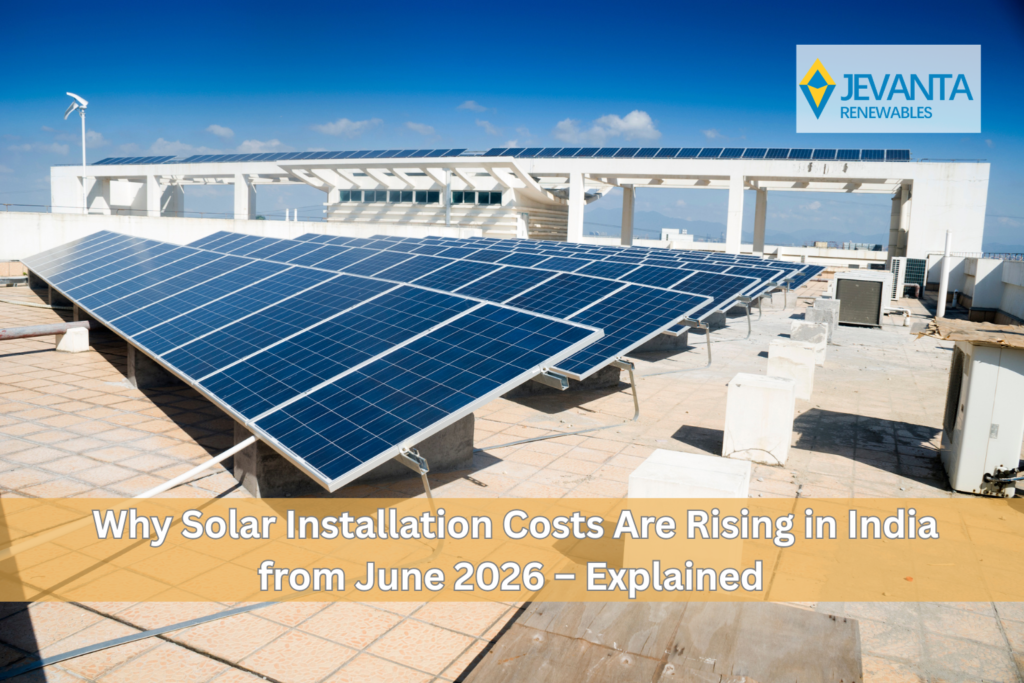
Your solar installer just quoted you 15–20% more than what a friend paid six months ago. The panels are the same. The roof is the same. So what changed?
Quite a lot, actually, and most of it happened quietly in government policy documents and ministry notifications that never made the headlines. If you’re a business owner, factory manager, or housing society committee member trying to make sense of the sudden uptick in solar installation costs in India, this is the explainer you’ve been looking for.
The ALMM List-II Mandate: The Policy Behind the Price Shift
The single biggest driver of rising solar installation costs right now is a regulatory update called ALMM List-II, the Approved List of Models and Manufacturers for solar PV cells, which becomes mandatory from June 1, 2026.
Here’s where things get interesting. Until now, ALMM compliance only applied to solar modules (List-I). List-II extends this to the cells inside those modules, and it mandates that for any project connected to government schemes, open access, or net metering, the cells themselves must be manufactured in India.
This sounds simple, but the supply-side implication is enormous. India’s certified domestic cell capacity currently accounts for less than 13% of the total module production capacity. As the June deadline approaches, EPCs and installers across the country are scrambling to secure ALMM List-II-compliant stock, and when demand concentrates on a constrained supply pool, prices rise. That’s not speculation. That’s basic market economics playing out in real time across India’s solar industry.
What the DCR Mandate Actually Means for Businesses and MSMEs
The Domestic Content Requirement (DCR) has existed in some form for years, but 2026 marks a meaningful escalation in enforcement and scope.
Starting June 2026, all government-backed solar projects, PM Surya Ghar residential installations, PM-KUSUM components, and net-metered systems must use modules made from Indian-certified cells. For private commercial or industrial projects without subsidies, non-DCR modules may still be permissible, but here’s the catch: ALMM compliance remains non-negotiable even there, and the pool of compliant, readily available stock is shrinking fast.
For MSMEs, manufacturing units, warehouses, and logistics parks, this creates a particularly acute challenge. Many smaller businesses had been banking on lower-cost imported panels (primarily from China) to keep their solar capital expenditure manageable. That calculation has changed. The Basic Customs Duty on imported solar modules already sits at 40%, with cells at 25%, and the new compliance requirements mean the cost-effective import route is being progressively closed off.
What most businesses don’t realise is that this isn’t just about immediate costs. If you commission a project after June 1 using non-compliant panels, you risk losing grid approval, losing subsidy eligibility, and potentially facing disputes with your DISCOM. The financial downside of getting this wrong is far greater than the incremental cost of getting it right.

Why Solar Panel Installation Costs in Mumbai Are Feeling the Pressure
Mumbai’s solar market has always had its own dynamics, higher labour costs, structural rooftop complexities in older industrial buildings, and limited installation windows in congested areas, all of which add to the baseline. In 2026, these existing pressures are compounded by the national policy shift.
Solar panel installation in Mumbai for the commercial and industrial segments currently ranges from ₹32–45 per watt for C&I systems and ₹38–65 per watt for residential setups. A 5 kW system in Mumbai will typically cost ₹7.8–₹9.2 lakh, somewhat higher than the national average due to local installation complexity.
The DCR compliance requirement is adding a modest but real premium. DCR-compliant modules using Indian-manufactured cells carry a slightly higher price than their non-DCR counterparts. In our experience working across Mumbai’s industrial belts, from Vikhroli to Bhiwandi, the businesses that lock in compliant supply chains early see far more predictable project economics than those that wait and scramble.
The BCD Effect, and Why Waiting Won’t Save You Money
A question we hear constantly: “Should I wait for prices to come down before installing solar?”
The honest answer right now is probably not.
The Basic Customs Duty structure (40% on modules, 25% on cells) was designed specifically to make waiting for cheaper imports a losing strategy. Add to that the tightening ALMM framework, the supply crunch for certified domestic cells, and the general upward trajectory of grid electricity tariffs across Maharashtra, and the math shifts decisively toward acting sooner.
Every month of delayed installation is a month of paying your current electricity bill in full. For a mid-sized factory consuming 50,000–1,00,000 units per month, that’s real money walking out the door. The structural cost decline in solar that we saw from 2017 to 2023 has plateaued, and with domestic manufacturing scaling up under the PLI scheme, costs will stabilise at a new floor, not fall significantly below it.
What Are the Best Solar Panels in India Under This New Framework?
The new policy environment effectively tips the scales toward higher-grade domestic technology, which, in practice, means this is a good moment to understand what you’re buying.
Monocrystalline panels remain the preferred choice for most rooftop installations in India, particularly in space-constrained commercial buildings. With efficiency rates between 18–22%, they perform better in low-light conditions, which is important for Mumbai’s occasional overcast periods during the monsoon months.
TOPCon technology is where the domestic manufacturing frontier is moving. Several Indian manufacturers are now producing TOPCon modules that rival global benchmarks, with better heat tolerance, improved bifacial gain, and longer performance warranties. For large-scale industrial or warehouse rooftop projects, TOPCon bifacial panels represent the best long-term yield per square metre.
PERC panels remain a cost-effective middle ground; DCR-compliant versions are increasingly available and offer solid ROI for applications where budget sensitivity outweighs space efficiency.
The key principle when evaluating the best solar panels in India right now is to look for ALMM List-II compliance first, then evaluate efficiency, warranty, and after-sales support. Choosing on price alone, especially from installers offering suspiciously cheap quotes using clearance stock of non-DCR panels, is a risk that could cost far more in the long run.
Flexible Financing: Why the Numbers Still Work
Here’s the part that often gets lost in conversations about rising solar installation costs: the financial case for solar in India hasn’t weakened, it’s shifted.
Under the CAPEX model, businesses invest upfront and own the asset. With 40% accelerated depreciation available for solar assets in Year 1, a ₹5 crore investment can generate ₹50 lakh+ in direct tax benefits in the first year alone, before a single unit of savings is counted.
Under RESCO and BOOT models, businesses consume solar power with zero upfront investment, paying only for units consumed, typically at rates 30–40% below their current grid tariff. For MSMEs not looking to commit capital, this remains one of the most powerful tools available.
The electricity bill savings (typically 60–70% reduction in commercial rooftop applications), combined with these financing structures, mean that solar continues to deliver attractive payback periods even as installation costs firm up.
The Right Time to Act Is Before the Deadline, Not After
June 1, 2026, is not a rumour circulating on installer WhatsApp groups; it is a firm regulatory deadline with no extension announced. EPCs and project developers who have not yet locked in ALMM List-II compliant supply for projects commissioning after that date are genuinely at risk.
For businesses and institutions in Mumbai and across Maharashtra, the message is straightforward: the cost of getting ahead of this shift is far lower than the cost of being caught flat-footed, whether that means losing subsidy eligibility, facing DISCOM grid approval delays, or simply paying spot prices for compliant modules when the deadline arrives.
If you’re evaluating solar for your facility, whether a factory, warehouse, commercial complex, or residential society, now is the time to work with an experienced EPC partner who understands both the technical and regulatory landscape.
At Jevanta Renewables, we’ve been navigating India’s renewable energy policy environment for over 25 years. From ALMM-compliant procurement to flexible financing structures, we help businesses make solar decisions they won’t have to revisit.
Get a free consultation with our team to understand exactly what June 2026 means for your solar project, before the window closes.