There’s a common assumption that solar subsidies in India are only for homeowners. Factory owners, warehouse operators, and commercial building managers often hear about the PM Surya Ghar scheme and immediately conclude it doesn’t apply to them. In most cases, they’re right, but they stop there, missing a far more significant set of financial incentives specifically designed for commercial solar installations at scale.
The incentive landscape for commercial and industrial (C&I) solar in Maharashtra in 2026 is not about capital subsidies in the traditional sense. It’s about accelerated depreciation, electricity duty holidays, net metering frameworks, and financing models that, taken together, can compress payback periods to as little as three years for large installations. For energy-intensive businesses in Maharashtra, one of India’s highest-tariff states, that’s a number worth sitting with.
Here’s what the picture actually looks like.
The Honest Answer: No Direct Subsidy, But Powerful Financial Incentives
Let’s address this clearly from the start. The PM Surya Ghar Muft Bijli Yojana, India’s flagship solar scheme, provides capital subsidies exclusively to residential consumers. Commercial and industrial installations are intentionally excluded from this central government subsidy.
What most business owners don’t realise is that the incentives available to C&I consumers are, in many cases, more financially significant than the residential subsidy structure. They just work differently.
The three pillars that make commercial solar installation in Maharashtra financially compelling in 2026 are accelerated depreciation, Maharashtra’s electricity duty exemption, and structured net metering under MSEDCL. Understanding how these work and how they compound is where the real conversation begins.
Accelerated Depreciation: The Most Underutilised Benefit
Commercial and industrial solar installations in India qualify for 40% accelerated depreciation in the first year of installation. In practical terms, this means a business can write off 40% of its solar asset value against taxable income in year one alone.
For a profitable business paying corporate tax, this benefit directly reduces the system’s effective capital cost, often by 10–15%, and materially brings forward the break-even point. When modelled over a full system lifecycle, the tax shield from accelerated depreciation can be worth as much as the net metering savings in the early years.
Here’s where things get interesting: this benefit is available regardless of system size, and it stacks with any financing incentives or GST input credits the business can claim for its solar investment. For any C&I entity that is currently profitable and paying tax, this is not a secondary consideration; it’s a core part of the financial case.
A qualified solar panel company in Mumbai or Maharashtra will factor this into your financial model at the proposal stage. If they don’t, that’s a signal to ask harder questions.

Maharashtra’s Electricity Duty Holiday: A 10-Year Incentive
Under Maharashtra’s Renewable Energy and Energy Storage Policy, captive green open-access projects that incorporate Battery Energy Storage Systems (BESS) are eligible for a 10-year exemption from electricity duty. Electricity duty is a state-level levy that typically adds a few percentage points to industrial electricity costs. For a large factory or industrial complex running heavy loads, exemption from this levy over a decade adds up to meaningful savings.
This policy was introduced as part of Maharashtra’s push to encourage not just solar adoption, but storage-coupled solar systems that actively manage grid load rather than simply generating power during daytime hours.
For industrial consumers evaluating larger installations, say, 500 kW and above, pairing rooftop solar with a BESS system in 2026 unlocks both the duty exemption and a more optimised energy profile under Maharashtra’s evolving Time-of-Day (ToD) tariff structure.
The Net Metering Framework in Maharashtra: What’s Changed in 2026
Maharashtra’s net metering landscape has seen significant regulatory development. As of February 2026, the state’s total rooftop solar capacity crossed 5,000 MW, a milestone that triggered the activation of Grid Support Charges (GSC) for installations above 10 kW under MERC Order 75 of 2025.
What this means for C&I consumers:
Installations up to 10 kW remain fully exempt from the GSC and continue to benefit from standard net metering.
Installations between 10 kW and 100 kW operate under net billing or standard net metering, depending on the consumer category.
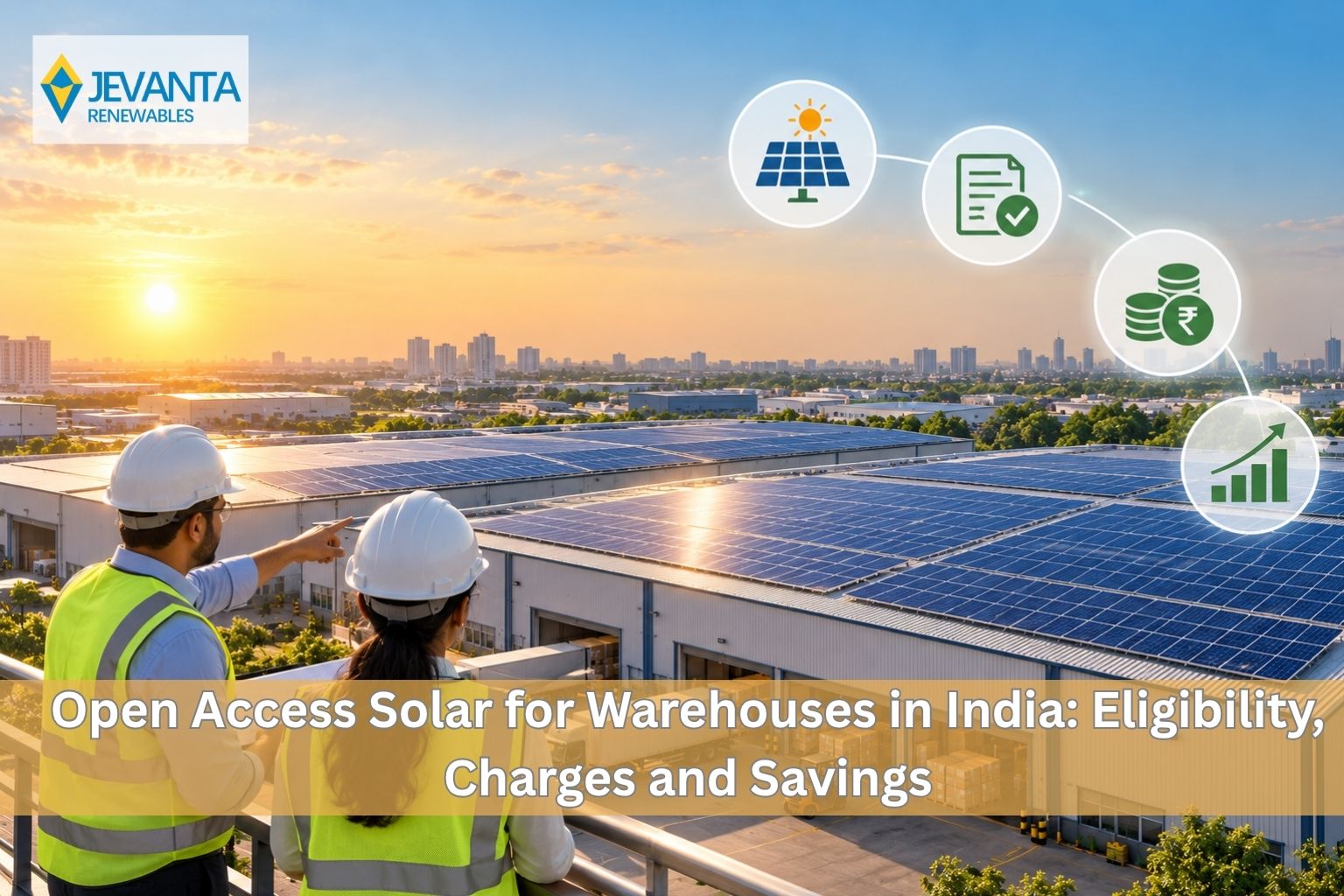
Installations above 100 kW now fall under the Green Open Access framework, in which excess generation is compensated at the Average Power Purchase Cost (APPC), approximately ₹3.5-₹4.0 per unit, rather than the full retail tariff. For context, HT industrial tariffs in Maharashtra range from ₹8 to ₹10 per unit. This gap makes it clear that, for larger C&I systems, the economic case rests primarily on self-consumption optimisation rather than export revenue.
MSEDCL’s net metering approval timelines for industrial connections typically run 45 to 75 days in 2026. Planning for this in project timelines, rather than treating it as an afterthought, is essential for keeping commissioning dates on track.
What most people don’t realise is that MERC has also introduced Virtual Net Metering (VNM) for multi-building industrial complexes or leased facilities, making solar viable for industrial setups that don’t own the connected roof outright.

Choosing the Right Commercial Solar Model for Your Business
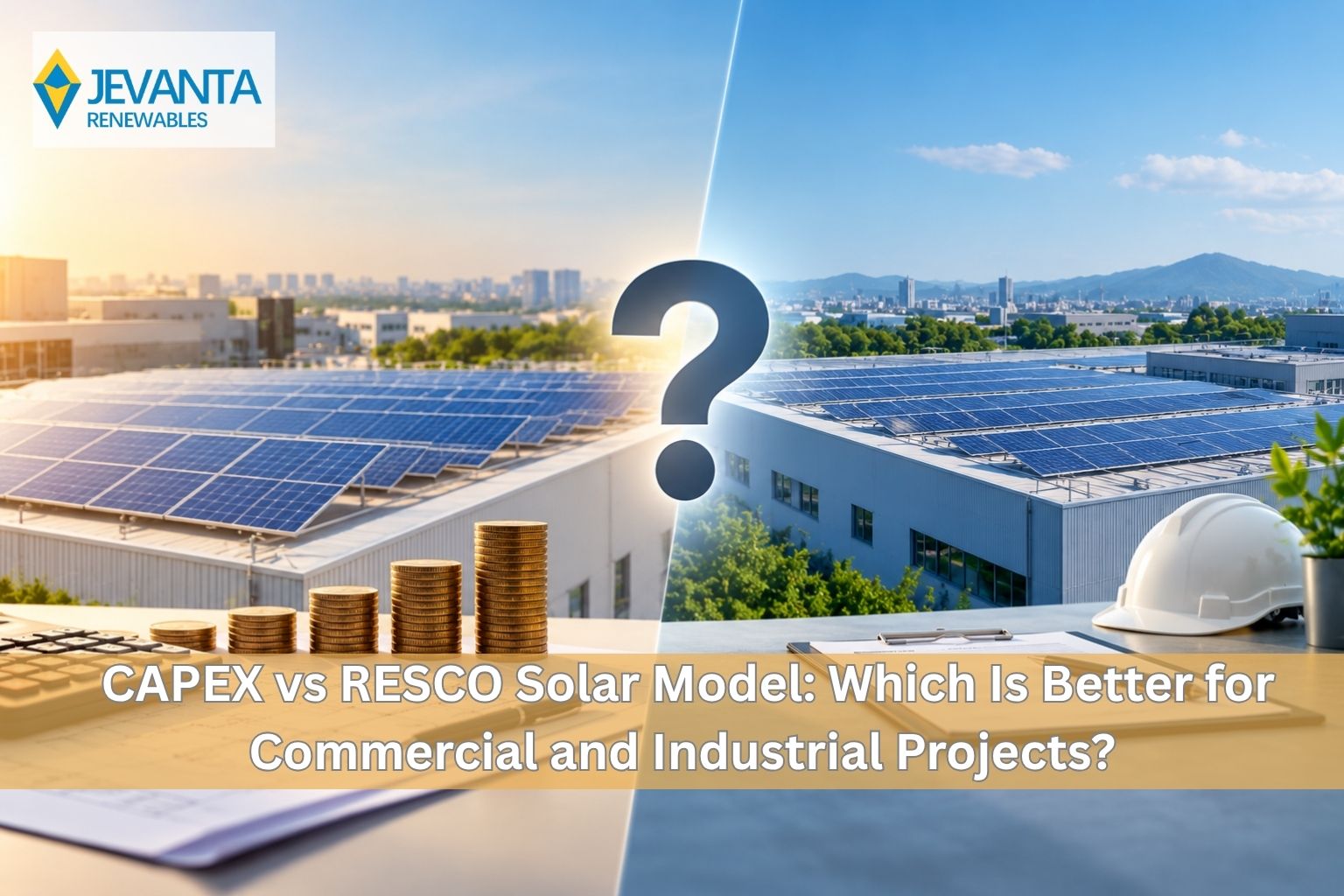
One size doesn’t fit all in C&I solar, and the right ownership and financing model directly affect your returns. In our experience at Jevanta Renewables, businesses that take the time to understand their options at this stage consistently achieve better outcomes than those that rush into installation.
CAPEX (Direct Ownership)
You own the system outright, typically financed through internal capital or a solar loan. You capture the full benefit of accelerated depreciation, net metering credits, and energy savings. Payback in Maharashtra’s high-tariff environment currently runs 3 to 4 years for rooftop systems and 4 to 5 years for ground-mounted industrial plants when tax benefits are factored in.
RESCO / PPA (Third-Party Ownership)
A developer like Jevanta Renewables installs and owns the solar system on your premises. You pay a fixed per-unit tariff, typically ₹4.0 to ₹5.5 per kWh, lower than your grid rate, with zero upfront capital expenditure. Ideal for businesses that prefer operational expense over capital allocation, or those whose tax position doesn’t make accelerated depreciation beneficial.
BOOT (Build, Own, Operate, Transfer)
The developer owns and operates the system for a defined period, then transfers ownership to the business. This model combines the low-entry benefits of RESCO with eventual ownership and the long-term economics that come with it.
Jevanta Renewables offers all three models, and for C&I clients, we work through a detailed scenario analysis before recommending one over another. The best solar subsidy in Maharashtra for a commercial building isn’t always a government scheme; it’s the financial model that fits how the business actually works.
What to Look for When Evaluating Commercial Solar Installation in Maharashtra
The C&I solar market has matured, but quality still varies significantly. Here are the things that matter most when evaluating a commercial solar project in 2026:
Module quality and compliance: From 2026, MNRE’s ALMM (Approved List of Models and Manufacturers) mandate applies to all grid-connected installations. Only ALMM-listed modules from Tier-1 manufacturers, Waaree, Adani Solar, Vikram, Tata Power Solar, and others, are compliant. Verify this before signing any installation contract.
MSEDCL liaison experience: Net metering approval timelines for industrial connections range from 45 to 90+ days depending on the documentation quality and the installer’s familiarity with MSEDCL’s process. An experienced solar panel company in Mumbai with a track record of 45 to 60-day approvals will save you significant project time.
System design for self-consumption: The regulatory shift from net metering to net billing for larger systems makes daytime load alignment critical. The best solar panels in India for commercial or industrial applications are those sized and positioned to maximise on-site consumption, not just generation.
O&M commitment: A 25-year system generating consistent returns needs consistent maintenance. Jevanta Renewables provides end-to-end Operations & Maintenance for all commercial and industrial projects, with AI-enabled monitoring that tracks inverter-level performance.

The Maharashtra Context: Why the Timing Is Right
Maharashtra currently has some of the highest industrial and commercial electricity tariffs in India; HT industrial consumers pay between ₹8 and ₹10 per unit across many categories. Against this backdrop, a well-designed solar system generating power at an effective cost of ₹2.5-₹3.5 per unit (post-incentives) represents a savings spread that is hard to ignore.
The state’s installed rooftop solar capacity crossing 5,000 MW in early 2026 is a signal, not of a saturated market, but of a mature one. The policy framework is clearer, the approval processes are more predictable, and the financing ecosystem has deepened. For businesses that have been watching and waiting, 2026 is the year to move from evaluation to execution.
What Jevanta Renewables Brings to Commercial & Industrial Solar Projects
With 25+ years of combined expertise, 950+ MW of commissioned projects across residential, commercial, and utility-scale segments, and a track record spanning Maharashtra, Gujarat, Odisha, and international markets, Jevanta Renewables approaches every C&I project as a long-term energy partnership, not a one-time installation.
We manage everything from feasibility studies and financial modelling to MSEDCL coordination, net meter commissioning, and ongoing O&M. Our flexible commercial models, CAPEX, RESCO, and BOOT mean businesses at every stage of readiness have a route in.
For commercial and industrial buildings in Maharashtra, the question in 2026 is no longer whether solar makes sense. The numbers have answered that. The question is whether your organisation is approaching it with the rigour it deserves.
If you’re ready to see what the numbers look like for your facility, start with a conversation.